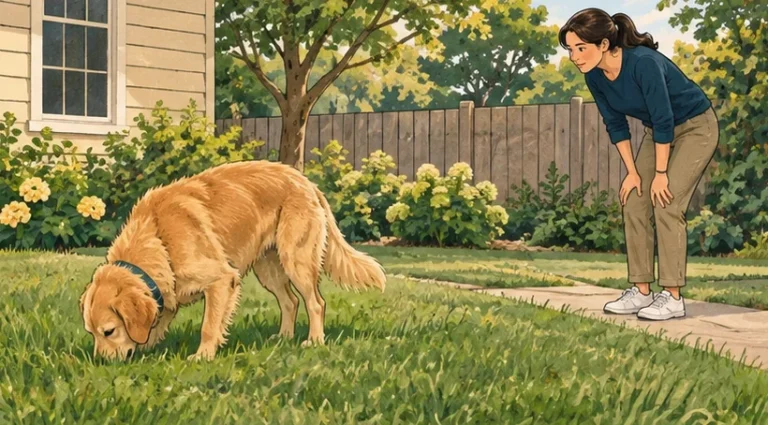
why does my dog constantly eat grass
If your dog heads for grass on nearly every walk or spends time grazing in the yard, it is natural to ask “why does my dog constantly eat grass?” Grass eating by itself does not show that a dog is ill or missing a nutrient. The useful first step is to compare the behavior with your dog’s usual routine and notice whether anything else has changed.
There is no single established reason that explains every dog’s grazing. Easy access, scavenging behavior, and the circumstances around a particular bout may all be relevant, but clues are not a diagnosis. A long-standing habit in a dog that seems well calls for a different response than sudden, urgent grazing alongside signs of discomfort.
why does my dog constantly eat grass? Start with the pattern
“Constantly” can describe very different behaviors: a few bites at the same point on each walk, a long session in the yard, or a sudden increase from what your dog normally does. Before deciding what it means, describe the pattern in concrete terms. Note how often grazing happens, how long it lasts, where it occurs, and whether your dog moves on when redirected.
The setting may offer a clue without explaining the cause. For example, a dog that nibbles in one familiar yard while waiting for its owner may simply have frequent access and an idle moment. A dog that newly searches for grass in several places or eats with unusual urgency is showing a change from baseline. That change deserves more attention than a stable, familiar routine.
Notice what happens before and after each episode. Does grazing tend to occur during one walk, while the dog is alone outdoors, or around a usual meal time? Does your dog take a few bites and continue, or return repeatedly? These observations can help a veterinarian understand the pattern if you later seek advice, but they do not identify a medical or behavioral cause on their own.
If your dog otherwise seems well, is eating and drinking normally, and has no concerning signs, you can keep a seven-day log. Record the time, place, likely context, approximate duration, and any vomiting or stool changes, including days when no grazing occurs. Treat the log as brief observation, not a reason to delay care; if your dog seems unwell or the behavior changes sharply, contact a veterinarian instead.
What the evidence can and cannot tell you
A common explanation is that dogs eat grass to make themselves vomit. Evidence summarized by VCA suggests this is not the usual pattern: fewer than one-quarter of grass-eating dogs in the cited studies vomited afterward, and only a minority showed signs of illness before eating grass. VCA’s overview of why dogs eat grass These findings do not rule out illness in an individual dog; they mean grass eating alone is not a reliable way to tell whether a dog feels sick.
Fiber is another possible part of the discussion. VCA explains that fiber supports digestion and the passage of stool, but this does not establish that every dog that eats grass needs more fiber. VCA’s overview of why dogs eat grass Grazing alone is not evidence of a nutrient deficiency, especially when a dog eats a complete, balanced diet. Avoid changing food or adding supplements based only on this behavior.
Access, boredom, and attention can shape grazing
Opportunity matters because grass is easy to reach in many yards and along walking routes. If your dog repeatedly eats from one patch, calmly guiding the dog away or choosing another route may reduce access. If the behavior shifts when the setting changes, that is a useful observation, not proof that access was the only reason for grazing.
A dog with little to do outdoors may spend time sniffing and nibbling. VCA describes boredom, reduced interaction, and anxiety as possible behavioral contributors, not explanations that apply to every dog. VCA’s overview of behavioral factors in grass eating Consider the whole routine, including walks, play, rest, and interaction suited to your dog. A link between grazing and quiet periods is worth noting, but it does not establish anxiety.
People’s reactions can also become part of the situation. If grass eating repeatedly brings a chase, scolding, or a lot of attention, the interruption may make that moment more engaging for some dogs. Avoid turning the episode into a contest. A calm cue followed by another activity is easier to manage and lets you observe whether the dog returns to grazing.
For example, if a dog starts nibbling while its person works in the yard, the person could offer a brief sniffing activity or a suitable puzzle before that quiet period, then observe what happens. VCA suggests mental stimulation, play, walks, and social opportunities as possible responses to boredom or unmet interaction needs. VCA’s overview of behavioral factors in grass eating Choose an alternative that fits the dog and setting rather than expecting one activity to solve every case.
| What you notice | Possible clue | Practical next step |
|---|---|---|
| One familiar patch | Easy access | Calmly redirect |
| Quiet outdoor periods | Boredom may contribute | Offer another activity |
| Sudden increase | Change from baseline | Check for other signs |
| Vomiting or discomfort | More than a habit question | Contact your veterinarian |
Check the lawn and the broader routine
Where a dog grazes matters, even if the behavior itself is familiar. Grass may have been treated with herbicides or pesticides, which the ASPCA warns can be toxic to dogs. ASPCA lawn and garden safety guidance Avoid letting your dog eat from a place where treatment may have occurred. If you cannot establish that an area is safe, use a different route or supervised outdoor space instead.
Grass can also be contaminated with intestinal parasites from fecal residue. VCA guidance on grass-related exposure A lawn that looks clean does not tell you what has been applied or whether other animals have used it. Take particular care with shared lawns, unfamiliar walking routes, and spots where animal waste is visible. Managing access is a practical precaution, not a way to determine why your dog grazes.
Review food and routine without jumping to a nutrient explanation. Note whether the diet recently changed, whether your dog is eating meals normally, and whether grazing began alongside a change in stool or signs of stomach discomfort. Those details can help a veterinarian assess the situation if you ask for advice. They are not a reason to add fiber, change food, or give a supplement without guidance tailored to your dog.
Keep parasite prevention current as directed by your veterinarian, especially because contaminated grass can be one route of exposure. Hart’s discussion of a possible ancestral parasite-related purpose is a hypothesis, not a reason to allow grazing or replace preventive care. Hart’s published review on animal behavior Separate the proposed explanation from the practical decision: grass is not a reliable treatment, and avoiding risky ground is safer.
How to manage a well dog’s grass eating
For a dog that otherwise seems well, start with supervision and gentle redirection. On a walk, notice when your dog lowers its head toward grass, then guide it onward or ask for a familiar behavior and reward cooperation. VCA describes redirecting attention and rewarding an alternative as ways to interrupt grazing. VCA guidance on redirecting grass eating Keep the interaction calm so the episode does not become the center of attention.
At home, manage access where possible and offer an activity that fits the situation. A dog that grazes during a quiet stretch might benefit from a walk, play, or an appropriate puzzle activity; a dog heading for an uncertain patch needs closer supervision and a different route. These steps address opportunity and engagement. They do not confirm a behavioral cause or prove that a medical problem is absent.
Use a seven-day log as a short observation tool, not a test your dog must pass. Record whether the dog was easy to redirect and whether grazing changes after you adjust access or routine. If the behavior remains frequent, grows more intense, or is joined by symptoms, share the notes with your veterinarian rather than extending the experiment. Do not use a tracking period to wait out a concerning change.
Avoid punishment, frightening interruptions, or forceful attempts to pull grass from your dog’s mouth. A calm cue and redirection are more practical and make it easier to observe what happens next. If you cannot reliably prevent access to grass that may be treated or contaminated, prioritize a safer area. General guidance in our Pet category is not a substitute for advice about an individual dog.
When grazing needs veterinary attention
Grass eating paired with signs of stomach discomfort deserves more attention than grazing alone. VCA notes that discomfort could reflect a medical problem and recommends veterinary assessment to rule out serious conditions. VCA guidance on grass eating with stomach discomfort You do not need to decide the cause at home. Tell the clinic when the behavior began, how often it happens, and what else you have noticed.
Vomiting is important to track and should not automatically be dismissed as an expected result of eating grass. Cornell advises taking unresolved vomiting seriously because it can lead to dehydration and electrolyte changes. Cornell guidance on vomiting in dogs Contact a veterinarian for blood in vomit, material resembling coffee grounds, lethargy, a painful belly, fever, or vomiting lasting more than 24 hours.
Cornell notes that an infrequent episode after eating grass may be isolated, while vomiting even once a week may indicate disease. Cornell guidance on vomiting in dogs That distinction cannot predict what is happening with an individual dog. If vomiting recurs or you are unsure, contact your veterinarian rather than relying on a behavior log or assuming the grass caused it.
Seek veterinary advice if grazing comes with signs of stomach discomfort, if the behavior changes sharply, or if your dog may have eaten grass from a treated area. Mention possible exposure and when it happened. If your dog appears acutely unwell, do not wait to see whether redirection works. For information about our approach to general pet-care content, read the Amader Poll Editorial Policy.
Frequently asked questions
Does grass eating mean my dog is sick?
Not on its own. A sudden change or grazing alongside signs of discomfort deserves more attention than a familiar, symptom-free habit.
Is my dog trying to vomit?
Not necessarily. Most grass-eating dogs in the evidence summarized by VCA did not vomit afterward, but recurring vomiting should be discussed with a veterinarian.
Does grass eating mean a nutrient deficiency?
No. Grazing alone does not establish a deficiency. Ask your veterinarian before changing food or adding supplements.
Should I let my dog eat grass?
Prevent access to grass that may be treated with chemicals or contaminated by feces. Supervise and redirect your dog toward a safer area.
Can I track the habit at home?
If your dog otherwise seems well, keep a seven-day note of timing, location, context, and symptoms. Stop tracking and seek veterinary guidance if concerning signs appear.
When should I call the veterinarian about vomiting?
Call for blood or coffee-ground-like material, lethargy, a painful belly, fever, vomiting lasting more than 24 hours, or recurring vomiting.
The bottom line
If you are still asking why does my dog constantly eat grass, look first at the pattern and your dog’s overall condition instead of assuming a nutrient shortage. Access, scavenging behavior, and the circumstances around grazing may help explain a routine, but no single explanation fits every dog. For an otherwise well dog, brief tracking and gentle redirection can clarify what is happening.
Keep your dog away from grass that may be treated or contaminated, and do not let a log or training plan delay care when symptoms appear. Recurring vomiting, stomach discomfort, or a sudden change deserves veterinary attention. For more on how we approach general pet-care information, see the Amader Poll Editorial Policy.