commands to teach dog: practical cues for daily life
Useful cues can make everyday routines easier: a dog can pause at an interior doorway, settle on a mat while you prepare dinner, or come over for a treat in a quiet room. If you came here looking for “commands to teach dog,” start with situations you actually encounter. A few clear signals are more useful than a long list of words.
A cue is a learned signal, not a promise that a dog will respond in every place or distraction level. Build the response with rewards, begin in calm surroundings, and use gates, leashes, or closed doors to manage situations while a skill is developing. The practical goal is to teach a useful behavior and make success easier, not to rely on a word as a safety barrier.
commands to teach dog: start with clear cues
Choose one short word or hand signal for each behavior, then make sure everyone who handles the dog uses it the same way. For example, one person might say “down” to mean lie down while another means get off the sofa; the dog then hears one signal attached to different actions. Give those behaviors separate cues, such as “lie down” and “off,” so the request is easier to understand.
Start with a quiet room, a few small treats, and a behavior your dog can already offer or learn easily. Say the cue once, pause, and mark the desired action with a brief word such as “yes” just as it happens, then promptly offer the treat. A clicker can also mark the moment if its sound has been paired with a reward. The marker tells the dog which action earned the reward, so timing matters more than a forceful voice.
If your dog does not respond, check whether the behavior has been practiced enough and whether the setting is too challenging. Move closer, reduce a distraction, or return to a simpler version instead of repeating the word several times. A cue signals when a behavior may pay off, but the dog’s learning history supports the response; practice in easy settings before gradually adding new places or distractions. AVSAB’s explanation of cues and consequences
Teach starter cues for settling
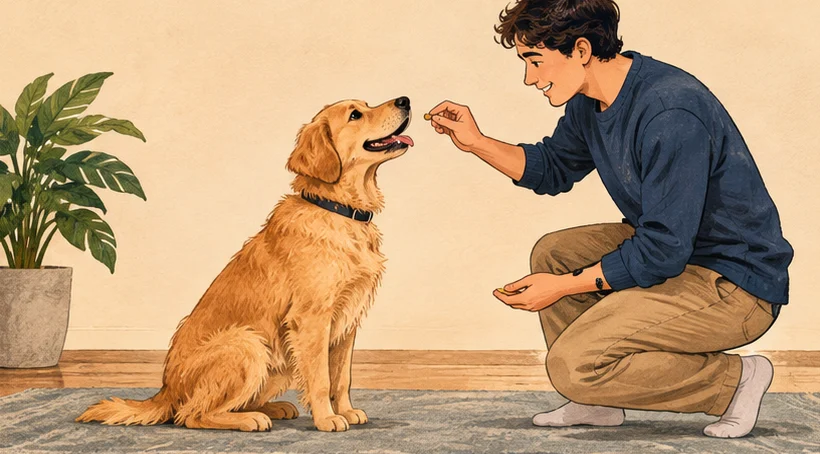
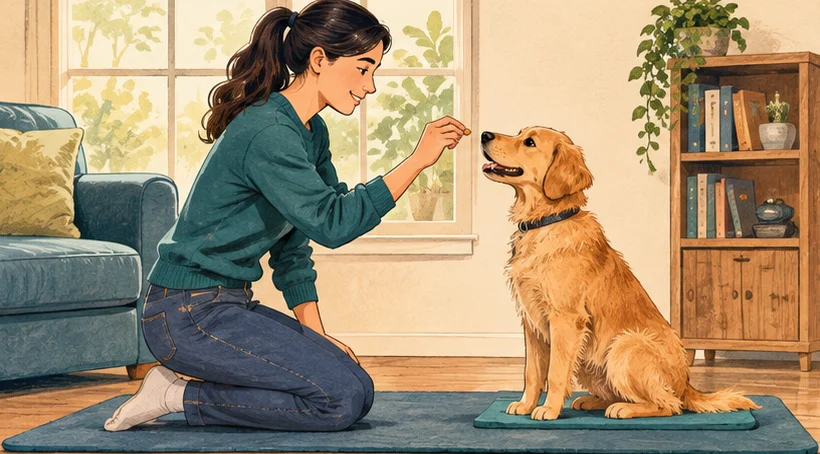
“Sit” can help with a brief pause before you set down a food bowl or open an interior door. In a quiet room, hold a treat near your dog’s nose and move it gently upward; the dog may shift into a sit while following it. Mark and reward when the bottom touches the floor. Once the movement is familiar, say “sit” just before it begins. If your dog backs away or jumps, make the hand movement smaller and try again.
Use “down” to mean lie down, not get off furniture, and teach the action without pushing your dog into position. You can reward a natural lie-down on a mat, or slowly lower a treat toward the floor between the front paws and mark when the dog lies down. If your dog stands or loses interest, pause and simplify the next attempt. A willing, rewarded response is more useful than trying to hold the dog in place.
A mat can become a familiar place to relax while you read or prepare a meal. Reward your dog for choosing to lie on it while you sit nearby, then continue to give treats while the dog remains settled. You can introduce a release word such as “free” before the dog moves, so the end of the exercise is clear. If you need to keep the dog away from hot cookware or visitors, use a gate or other safe arrangement rather than expecting the mat cue to do that job alone.
Add “wait” and “stay” as separate skills
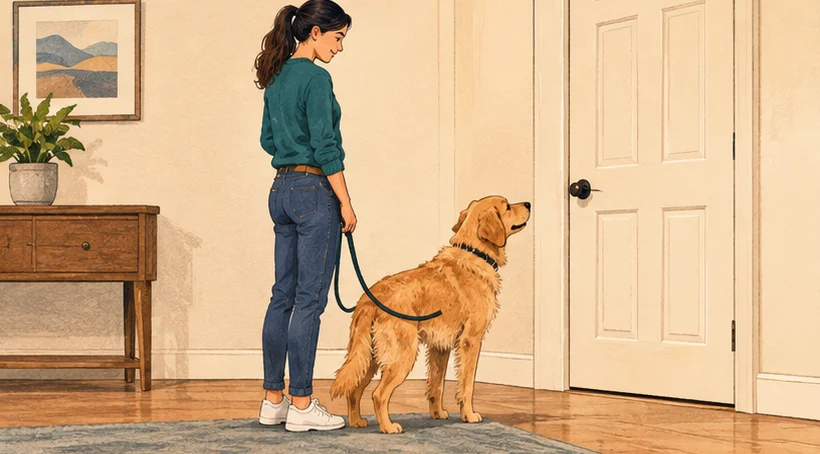
There is no single required household meaning for “wait” and “stay,” so decide how you will use each word and keep the distinction consistent. For example, “wait” can mean a short pause before moving through a doorway, while “stay” can mean remain in place until released. Tell everyone who handles the dog which signal means what. A clear division prevents one cue from predicting different actions in similar moments.
Practice a brief “wait” at an interior doorway with no traffic or other hazard nearby. Ask your dog to pause a short distance from the opening, reward the pause, then say your release word and walk through together. For a “stay,” ask for a sit or down, give the cue, and reward after a moment while the dog is still in position. Release before the dog gets up, then repeat. Keep early repetitions easy enough that your dog can succeed.
Add one challenge at a time: a little more duration, one small step away, or a mild change in the room. If your dog gets up, calmly reset and make the next repetition easier instead of scolding or saying the cue again and again. At an exterior door, a pause is not a barrier; use a leash, gate, or closed door to prevent access to hazards while practicing. AVSAB’s position statement on humane dog training
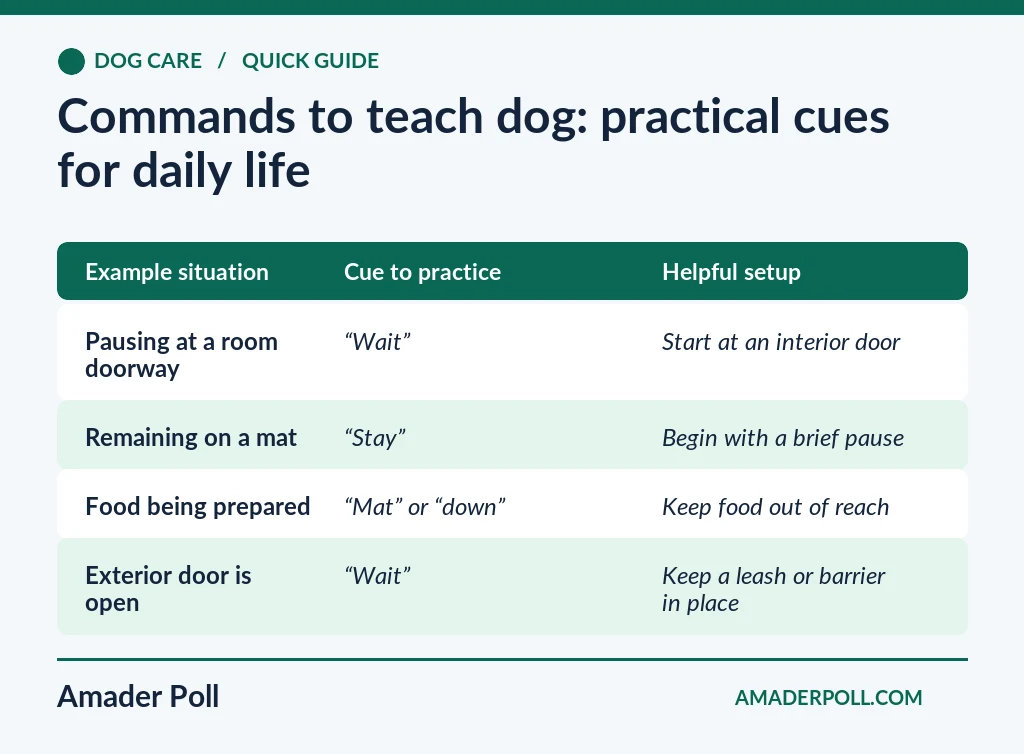
| Example situation | Cue to practice | Helpful setup |
|---|---|---|
| Pausing at a room doorway | “Wait” | Start at an interior door |
| Remaining on a mat | “Stay” | Begin with a brief pause |
| Food being prepared | “Mat” or “down” | Keep food out of reach |
| Exterior door is open | “Wait” | Keep a leash or barrier in place |
Teach “leave it” and “drop” separately
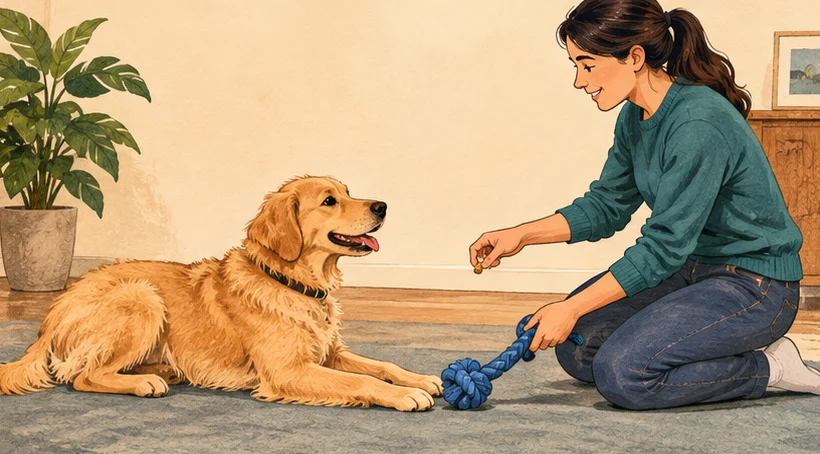
“Leave it” can ask a dog to turn away from something, while “drop” can ask the dog to release an item already in its mouth. Teach these as different actions with safe, low-value objects in a quiet room. For “leave it,” place a treat in a closed hand and wait. When your dog stops nosing or licking your hand, mark that choice and reward with a different treat from your other hand. Add the cue as the turn-away response becomes familiar.
For “drop,” offer a toy your dog is comfortable holding, then present a treat near the dog’s nose. Mark and reward when the toy is released. If it is appropriate for the toy and situation, return it so releasing does not always end the game. Once the exchange is working, say “drop” just before the release. This teaches a useful trade rather than making every release predict that a valued activity disappears.
If your dog stiffens, guards an object, or seems distressed, do not grab the item or turn the exercise into a contest. Keep people away from the object and seek help from a qualified, reward-based behavior professional. For routine practice, choose an item the dog can comfortably release; if the dog is not relaxed, stop and use management instead of trying to force the lesson.
Build recall gradually and manage the surroundings
A recall cue such as “come” is useful, but begin in an easy, controlled place. Stand a few steps away indoors, say your dog’s name and “come” once, and reward generously when the dog reaches you. Crouching or moving backward may encourage the approach. If your dog does not come, reduce the distance or distractions next time rather than repeating the cue from farther away.
Keep returning to you worthwhile with food, play, or another reward your dog enjoys. Sometimes let your dog return to a safe activity afterward, so coming does not always mean that play or a walk is over. If the outcome after a recall is consistently the end of something enjoyable, the cue may become less appealing in that setting. AVSAB’s explanation of cues and consequences
Increase difficulty in small steps: practice in another room, then a familiar outdoor area with secure boundaries, and later around mild distractions if your dog is succeeding. Do not rely on a newly learned cue as the only safeguard in an open or hazardous place; no recall cue guarantees a response in every situation. Keep your dog on leash where appropriate and use secure boundaries. If you need to leave, approach and guide your dog safely rather than calling repeatedly from a distance.
Practice in everyday settings and adjust the plan
A dog may understand “sit” in the kitchen but not yet connect the same cue with a porch or walking path. Treat each new setting as a fresh lesson: stand close, make the request easy, and reward a simple success. Add only one small challenge at a time, such as a new room or a slightly longer pause. If your dog misses the cue, make the next attempt easier rather than assuming the dog is deliberately ignoring you.
Use ordinary routines for brief practice. You might reward a sit before placing a bowl on the floor, a moment on the mat while you read, or a pause at an interior doorway. If attention fades or several attempts are unsuccessful, stop and change the setup. A treat that works in a quiet room may not compete with an exciting distraction, so moving away or returning to a calmer place can be the more useful decision.
For example, if a dog jumps up when visitors arrive, use a leash or gate to manage the greeting and reward four paws on the floor or a familiar sit. This changes the setup while reinforcing a behavior you want to see; AVSAB recommends reward-based methods for common training skills and unwanted behavior. AVSAB’s position statement on humane dog training For serious fear, aggression, or anxiety, basic cues are not a substitute for an individual behavior plan. A veterinarian or qualified behavior professional can help determine what support is appropriate.
Choose a trainer who can explain how they teach skills and what they do when a dog struggles. The American Veterinary Society of Animal Behavior recommends reward-based methods and states that aversive methods should not be used in canine training. AVSAB’s position statement on humane dog training A practical question is whether the trainer focuses on teaching a desired response and changing the environment, rather than relying on pain, force, or fear. More pet-care articles are available in Amader Poll’s Pet category, and the site’s publishing approach is explained in its editorial policy.
Frequently asked questions
What cues should I teach first?
Start with behaviors that fit your routine, such as “sit,” “down,” “wait,” “drop,” and “come.” Teach one at a time in a calm setting.
How long should a training session be?
Keep practice brief and stop while your dog is still engaged. If focus fades, simplify the task or take a break.
Should I repeat a cue if my dog does not respond?
Give the cue once, then make the next attempt easier by reducing distance or distraction. Repeating it more forcefully does not replace practice.
Can I use rewards other than food?
Yes. Food is one practical reward, and play or another suitable reward may also work. AVSAB’s overview of reward-based training
Do “wait” and “stay” mean the same thing?
You can define them differently, such as a brief pause for “wait” and remaining in place until released for “stay.” Use your chosen meanings consistently.
Will my dog always come when called?
No cue guarantees a response in every situation. Practice in easy settings, reward returns, and use a leash or secure boundary when needed.
The bottom line
When narrowing down “commands to teach dog” for daily life, begin with a few clear cues and reward the behavior you want. Practice in calm surroundings, use each signal consistently, and add difficulty gradually. When a response breaks down, change the setup or return to an easier step instead of raising your voice or punishing a mistake.
Pair training with practical management: a leash, gate, or closed door can help prevent a problem while a skill develops. Cues are useful, but they are not guarantees, especially around hazards or strong distractions. Use reward-based methods, and seek individualized support when a serious behavior concern calls for more than basic training.