
why do mother dogs eat their puppies poop? What to watch for
If you have just watched a new mother clean her puppies, it is understandable to wonder what is normal and what might need attention. The question why do mother dogs eat their puppies poop does not have a definitive answer in the veterinary references used here: they describe some newborn care behaviors, but do not explain stool eating specifically.
The most useful distinction is whether the mother is otherwise settled and the puppies can nurse, or whether this is a sudden, persistent change that disrupts care. Observe the dam and litter together, keep the space calm, and note what happens before and after the behavior so you can share specific details with your veterinarian if needed.
why do mother dogs eat their puppies poop?
A mother dog eating puppy stool might appear to be nest cleanup, but the available veterinary guidance does not establish that explanation or say that the behavior is expected at a particular age. It describes a mother licking a newborn to remove remaining membranes and fluids and help initiate breathing, which is a specific example of maternal care immediately after birth, not evidence about eating stool. UC Davis guidance on normal whelping
That means the action alone cannot tell you whether the mother is healthy or whether the puppies are thriving. Look at the whole situation: does she return to resting or nursing, and can the puppies reach a teat and settle? For example, a single cleanup followed by calm nursing gives a different picture from a mother who repeatedly leaves the litter or interrupts feeding.
Newborn puppies depend on their mother for more than milk. The MSD Veterinary Manual explains that maternal grooming stimulates them to eliminate and that they begin to eliminate without this stimulation during the transitional period. MSD Veterinary Manual on early dog behavior This helps explain why a mother may lick a newborn around the time it passes stool. It does not establish why she might swallow it or how often that occurs.
What early maternal care can and cannot tell you

Some normal care can look intense to someone watching a litter for the first time. UC Davis describes a mother licking a newborn to clear membranes and fluids and stimulate breathing, and recommends allowing maternal participation and bonding as much as possible. That guidance concerns care around birth; it is not a rule to ignore a puppy that appears unsafe or cannot nurse. UC Davis guidance on normal whelping
Mothers may also move puppies or rearrange them in the nesting area, especially after delivering a puppy. Merck says the mother should then assume a normal nursing position, so watch what happens after the move instead of interrupting every adjustment. If she settles and the litter can nurse, quiet observation may be reasonable; if she leaves the puppies unattended or will not allow nursing, contact a veterinarian for advice. Merck Veterinary Manual guidance on postpartum problems
Maternal attention is not always well-timed or gentle. Merck notes that a nervous mother may ignore newborns or give them excessive attention, and that excess grooming can prevent a puppy from nursing. So grooming alone is not a reliable measure of whether all is well: check whether each puppy can feed and settle, and seek veterinary advice if repeated grooming keeps interrupting nursing. Merck Veterinary Manual guidance on postpartum problems
How to judge one event versus a pattern
A brief, isolated event is best assessed alongside the mother’s comfort and the puppies’ access to her. Notice whether she returns to resting or nursing, whether the litter is left alone, and whether a puppy appears unable to feed. These observations do not diagnose a problem, but they help you describe whether the behavior was a passing moment or part of a pattern affecting care.
A sudden change deserves attention even if you do not see another warning sign. For example, if a mother who had been settled begins repeatedly leaving the puppies to attend to the nest, record when the change began and what happens before and afterward. If it persists, escalates, or makes nursing difficult, call your veterinarian rather than waiting for an arbitrary number of episodes; the supplied guidance gives no episode count that makes waiting safe.
Consider changes in both the mother and the litter rather than focusing only on stool. Merck lists continued straining as if still in labor, abnormal vulvar discharge, fever, and lethargy among signs associated with postpartum metritis. If you notice any of these, contact a veterinarian promptly and report them directly; do not assume the behavior explains them or wait for it to stop before asking for help. Merck Veterinary Manual guidance on postpartum problems
Protect nursing while keeping the nest calm

Avoid scolding, frightening, or punishing the mother. Merck advises that unfamiliar surroundings or strangers may interfere with maternal instincts or milk letdown, so a familiar, quiet space is a sensible starting point. Observe from nearby, and intervene for a clear safety concern or on veterinary advice rather than repeatedly reaching into the nest to stop a behavior that looks unpleasant. Merck Veterinary Manual guidance on postpartum problems
Do not routinely separate puppies from their mother just to prevent cleanup. UC Davis recommends allowing maternal participation and bonding after birth, while Merck notes that unfamiliar surroundings and disturbance can interfere with maternal care. If a puppy appears to be in immediate danger, keep any necessary handling brief and gentle, then contact your veterinarian for advice specific to the situation. UC Davis guidance on normal whelping Merck Veterinary Manual guidance on postpartum problems
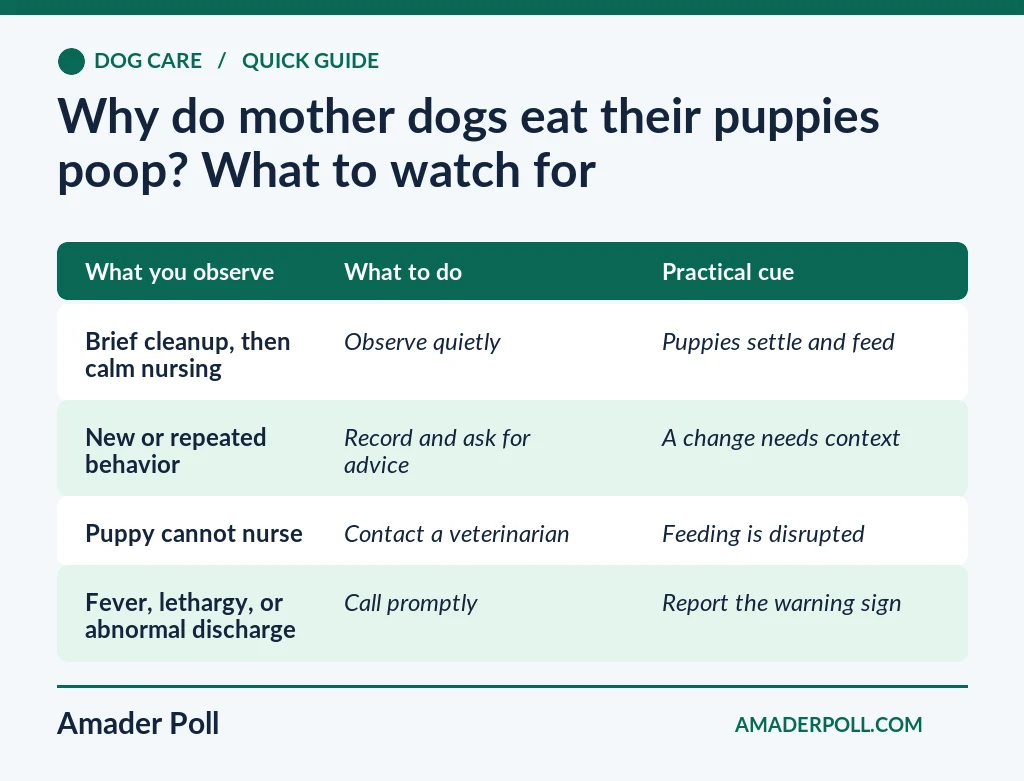
Use this simple guide to decide what to do next; it is not a diagnostic tool. For example, if a puppy is repeatedly unable to reach a teat, that is more urgent than an isolated cleanup followed by quiet nursing. If the signs do not fit neatly into a row, describe what you see to your veterinarian and follow their guidance.
| What you observe | What to do | Practical cue |
|---|---|---|
| Brief cleanup, then calm nursing | Observe quietly | Puppies settle and feed |
| New or repeated behavior | Record and ask for advice | A change needs context |
| Puppy cannot nurse | Contact a veterinarian | Feeding is disrupted |
| Fever, lethargy, or abnormal discharge | Call promptly | Report the warning sign |
Keep the nesting area clean and monitor the litter

A clean nesting area matters, but constant rearranging can disturb the mother and make it harder to see how the litter is doing. When bedding is soiled, choose a calm moment to change it, keep the puppies together and warm, and return them promptly. If the mother becomes distressed or will not settle after the change, pause further rearranging and ask your veterinarian how to manage the space.
Keep the surroundings familiar and limit unnecessary visitors or activity. Merck advises that bitches deliver in a familiar area where they will not be disturbed, because unfamiliar surroundings or strangers may interfere with maternal instincts or milk letdown. In practice, a quiet bedding change to address soiling is different from repeatedly moving the nest or handling puppies without a clear care or safety reason. Merck Veterinary Manual guidance on postpartum problems
Quiet checks can tell you more than frequently picking up the puppies. From a respectful distance, see whether the mother lies down to nurse, whether the puppies can reach her, and whether they settle afterward. Merck notes that neonatal contentment and daily weight gain after the first 24 hours indicate adequate lactation; if you are uncertain about feeding or growth, ask your veterinarian how to monitor this litter. Merck Veterinary Manual guidance on postpartum problems
A short written record can turn a vague concern into useful information. Note when you saw the behavior, whether the mother was resting or nursing, how often it recurs, and whether a puppy missed a chance to feed. For instance, “twice after nursing, then she settled” gives the clinic more to work with than “she does it all the time.” Record observations, not a guessed medical cause.
When to call and what to report
Contact your veterinarian if the behavior is sudden and persistent, interferes with nursing, or occurs alongside a mother who seems unable to settle or care for her puppies. Call promptly for continued straining, abnormal discharge, fever, or lethargy, which Merck lists among signs associated with postpartum metritis. The stool-eating behavior itself does not identify a cause, so report any other signs separately and follow the clinic’s advice about urgency. Merck Veterinary Manual guidance on postpartum problems
When you call, give a simple timeline: when the puppies were born, when you first noticed the behavior, how often it happens, and whether the mother returns to nursing. Mention if a puppy cannot nurse or is left unattended, and describe changes in the mother that you actually observed. If you are unsure whether the behavior is persistent, explain the number and timing of the occasions rather than trying to label it.
A useful call focuses on what has changed and whether feeding is affected. For example, tell the clinic if the mother is eating and resting as usual, if she settles with the litter, or if a puppy repeatedly misses nursing; do not present a guessed explanation as a fact. Do not give medication or supplements based only on this behavior unless your veterinarian recommends them for this dog. For general dog-care reading, see Amader Poll’s Pet category; the Amader Poll Editorial Policy explains the publication’s approach, but neither replaces individual veterinary advice.
Frequently asked questions
Is this behavior normal for a mother dog?
The veterinary references here do not establish why or when it happens. Look at whether the mother is settled and the puppies can nurse, and call your veterinarian if it is new, persistent, or disruptive.
Should I stop the mother from doing it?
Do not punish her or routinely separate her from the puppies. Observe calmly and seek veterinary advice if the behavior interferes with care.
Does eating puppy stool mean the mother is sick?
Not by itself; the behavior alone does not identify a cause. Fever, lethargy, abnormal discharge, or continued straining are reasons to contact a veterinarian promptly.
What if she keeps licking a puppy?
Check whether the puppy can nurse and settle. Excess grooming may prevent nursing, so contact your veterinarian if feeding is repeatedly interrupted. Merck Veterinary Manual guidance on postpartum problems
Should I clean the nest immediately?
Keep it clean, but avoid repeated disturbance. Replace soiled bedding calmly when practical, and ask your veterinarian for advice if cleaning unsettles the mother.
What should I tell the veterinarian?
Share when the behavior began, how often it happens, whether the mother is nursing, and any changes in her or the puppies. Report warning signs directly rather than guessing at a cause.
The bottom line
why do mother dogs eat their puppies poop? The available veterinary references describe newborn grooming and maternal care, but do not give a definitive explanation for stool eating. A calm mother who returns to nursing and puppies that can feed present a different situation from a sudden or repeated behavior that disrupts care.
Do not punish the mother or interfere without a clear reason. Keep the nest familiar, observe the dam and litter together, and contact a veterinarian if nursing is disrupted, the behavior persists or changes sharply, or the mother shows signs such as fever, lethargy, continued straining, or abnormal discharge.