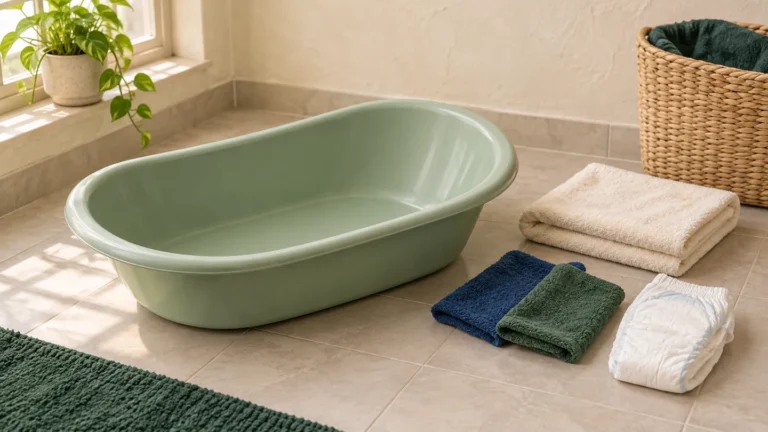
how to give a newborn a bath in a tub: a safe setup-to-drying guide
Knowing how to give a newborn a bath in a tub starts before your baby gets wet. A ready room, a suitable infant tub, checked water, and supplies within reach help you stay beside your baby and keep a hand on them throughout the bath.
This guide focuses on readiness, preparation, supervision, and drying. The advice is general; if your baby’s clinician has given you different instructions for your child, follow those. For related background on timing and frequency, see our newborn bathing guide.
1. Check whether your baby is ready for a tub bath
Wait until the umbilical cord stump has fallen off and the area has healed before placing your newborn in a tub. Until then, use sponge baths, which do not involve putting the baby in water; the stump usually falls off within about one or two weeks. HealthyChildren’s newborn bathing guidance If the stump remains beyond that time, the guidance recommends asking your baby’s doctor.
Once the area has healed, you can try a gentle, brief bath in an infant tub. Some babies protest their first tub bath. If yours does, the American Academy of Pediatrics advises going back to sponge baths for a week or two before trying again. HealthyChildren’s newborn bathing guidance The practical decision is straightforward: if healing is not complete, sponge bathe; if it is, a short tub bath is an option.
A newborn does not need a full bath every day. The AAP says three baths per week during a baby’s first year may be enough, and more frequent bathing can dry the skin. HealthyChildren’s newborn bathing guidance A tub bath can be reserved for bath days rather than treated as a daily requirement. Explore our Baby Bath section for related topics.
Readiness also depends on the adult’s ability to supervise without interruption. Before lifting your baby, make sure you can stay beside the tub and that the towel and washing supplies are close. If you are tired, need to find something, or expect to answer the door, wait until you can give the bath your full attention. Bath time can be postponed; it should not start while you are still arranging the essentials.
2. Set up the tub and room before lifting your baby
Choose an infant tub designed to help keep a baby from sliding. The AAP, citing the U.S. Consumer Product Safety Commission, recommends a hard-plastic baby bathtub with a sloped, textured surface or a sling, and says to use a tub manufactured on or after October 2, 2017, to meet current safety standards. HealthyChildren’s newborn bathing guidance Do not substitute a bath seat: it can tip, and a baby can slip out. HealthyChildren’s infant water-safety guidance
Place the towel and other supplies where you can reach them without turning away or taking a hand off your baby. Decide where you will put your baby after lifting them out, too. That small bit of planning avoids having to pause near the water to decide where to go or search for a towel while holding your baby.
Before lifting, check the whole setup. If the tub is not ready, the water has not been checked, or supplies are out of reach, finish preparing while your baby is still safely out of the bath. A quick check before carrying your baby over is more useful than trying to remember what is missing once the bath has begun.
| Check | Ready before lifting | If not ready |
|---|---|---|
| Infant tub | Suitable tub set up | Prepare it first |
| Water | Warm, shallow, faucet off | Adjust and recheck |
| Supplies | Towel and washing items close | Bring them within reach |
| Supervision | Adult can stay beside baby | Wait until ready |
Some families use a sink, but sinks can be slippery and may have faucets or handles sticking out. The AAP advises extra care and says to turn off the faucet before placing a baby in standing water. HealthyChildren’s newborn bathing guidance If the sink makes it harder to stay close and maintain contact, use a suitable infant tub instead. A bath seat is not a substitute for either option.
3. how to give a newborn a bath in a tub: check the water first
Fill the infant tub before lifting your baby, then check the water just before the bath. The AAP recommends about 2 inches of water that feels warm, not hot, to the inside of your wrist or elbow. HealthyChildren’s newborn bathing guidance The baby should be placed in standing water, not water flowing from a tap or faucet sprayer.
Turn off the faucet before placing your baby in the water and leave it off throughout the bath. The AAP warns against bathing a baby in running water or using a faucet-mounted sprayer because water temperature can fluctuate as it moves through household pipes, and even small changes can scald. HealthyChildren’s newborn bathing guidance If the water needs adjusting, take your baby out first, make the adjustment, and recheck before continuing.
The AAP also recommends setting the hottest temperature at the faucet to no more than 120°F to help prevent scalds. HealthyChildren’s infant water-safety guidance This household safeguard does not replace checking the bath water itself. Use your wrist or elbow to make sure the bath feels warm rather than hot immediately before bringing your baby to the tub.
Shallow water still requires constant adult attention. Babies can drown in as little as 1 or 2 inches of water, and drowning can happen silently and within seconds. HealthyChildren’s infant water-safety guidance Keeping the water shallow limits how much is in the tub; it does not make it safe to step away or leave a baby with a sibling.
4. Keep a hand on your baby throughout the bath
When you lift your baby, stay beside the tub and keep a hand on them at all times. The AAP calls this touch supervision and recommends keeping a towel and other bath supplies within reach so you can maintain contact. HealthyChildren’s newborn bathing guidance Being in the same room is not enough if your attention or contact has shifted elsewhere.
Plan for interruptions before bath time begins. If the phone rings, someone knocks, or you realize a towel is missing, take your baby with you rather than leaving them in the tub. The AAP gives this advice even when a supportive infant tub or bath seat is being used. HealthyChildren’s infant water-safety guidance Do not rely on a quick trip away or on the assumption that your baby will stay still.
A young sibling should not be responsible for watching the baby, even if they want to help. The CPSC says never to leave a baby alone or with young siblings in a bathtub, even for a second, and advises keeping the baby within arm’s reach. CPSC’s in-home drowning prevention guidance A sibling can bring a towel before the bath, but an adult must provide direct supervision throughout.
Keep the first tub baths brief and uncomplicated. If your baby protests, stop the attempt rather than trying to finish a full routine; the AAP advises returning to sponge baths for a week or two before trying again. HealthyChildren’s newborn bathing guidance For example, if your baby becomes upset as you begin, you can end the bath and try another day.
5. Keep the washing routine simple
Use the supplies you prepared and keep your attention on your baby. The AAP advises making early baths gentle and brief, with supplies close at hand. HealthyChildren’s newborn bathing guidance You do not need to add a long or elaborate routine to a first bath. Choose only the steps you can manage while staying beside your baby and maintaining contact.
Keep the faucet off while you wash. If you need another item, do not leave your baby in the tub to get it. Take the baby out first, then return only when the setup is ready; if the water needs to be adjusted, check it again before placing the baby back in. Preparing before bath time and solving a problem while the baby is in the water are different situations.
If you are unsure whether the umbilical area has healed, do not use a tub bath to find out. The AAP recommends sponge baths until the stump falls off and the area heals. HealthyChildren’s newborn bathing guidance Ask your baby’s doctor for individual guidance if you are uncertain, rather than placing the baby in water before the area is ready.
6. Lift your baby out and dry them
Have the dry towel ready before the bath starts and within reach, so you do not need to leave your baby to retrieve it. When the bath is over, lift your baby out and use the towel to dry them. The AAP lists a dry towel among the supplies to prepare in advance and emphasizes keeping newborns warm during sponge baths. HealthyChildren’s newborn bathing guidance
Keep your baby with you as you finish drying and dressing them. Gather clothing or other items before the bath rather than leaving the baby on a surface while you fetch something. The same practical rule applies from start to finish: if you need to move away or handle an interruption, take your baby with you.
Once your baby is out of the bath and safely settled, empty the tub. The CPSC advises emptying containers with liquids immediately after use. CPSC’s in-home drowning prevention guidance This removes standing water after the bath, but it does not replace close supervision while your baby is in or near the tub.
A useful routine is one you can complete without rushing or leaving your baby unattended. If the baby is not ready for a tub, use a sponge bath; if the room is not ready, wait before lifting; if a problem comes up during the bath, take the baby out. These choices keep the bath manageable while preserving the essential safety steps.
Frequently asked questions
When can a newborn have a tub bath?
Wait until the umbilical stump has fallen off and the area has healed. Use sponge baths until then. HealthyChildren’s newborn bathing guidance
How much water should be in the infant tub?
The AAP recommends about 2 inches of warm, not hot, water. Check it with your wrist or elbow before placing your baby in the tub. HealthyChildren’s newborn bathing guidance
Can I leave my baby for just a moment?
No. Stay beside the tub and keep a hand on your baby; if you need to leave, take them with you. HealthyChildren’s infant water-safety guidance
Is a bath seat a safe substitute for an infant tub?
No. Bath seats can tip, and babies can slip out of them. HealthyChildren’s infant water-safety guidance
What if my baby cries during the first bath?
Keep the attempt brief and stop if your baby protests. You can return to sponge baths for a week or two before trying again. HealthyChildren’s newborn bathing guidance
How often does a newborn need a bath?
A full bath is not needed every day for most newborns; three baths a week during the first year may be enough. HealthyChildren’s newborn bathing guidance
The bottom line
Learning how to give a newborn a bath in a tub starts with waiting until the umbilical area has healed, choosing a suitable infant tub, and preparing the towel and supplies before lifting your baby. Fill the tub first, check for warm, shallow water, and turn off the faucet before your baby goes in.
Stay beside your baby and keep a hand on them throughout the bath, then lift them out and dry them with the towel you prepared. If the setup is incomplete, wait; if your baby protests or you need to leave, take them out. A brief bath with these decisions built in is enough.