
do dogs need distemper shots every year? How to check when a booster is due
If you’re asking “do dogs need distemper shots every year,” the usual answer is no. For dogs following the American Animal Hospital Association (AAHA) schedule, the distemper vaccine is given as a puppy series, followed by a booster within one year after the series. After that, AAHA recommends boosters every three years, not every year. AAHA guidance on canine distemper
That interval does not mean dogs only need veterinary attention every three years. An annual checkup can help a veterinarian review the dog’s records, health, lifestyle, and vaccine needs, while rabies vaccination follows separate legal requirements. The useful distinction is between an annual visit and an annual distemper shot: one may be appropriate even when the other is not due.
do dogs need distemper shots every year? What each step means
Distemper is a core vaccine in AAHA’s recommendations, meaning it is recommended for all dogs unless there is a specific medical reason not to vaccinate. The schedule has several stages, so the three-year interval applies only after the primary series and its follow-up booster. A dog’s age and vaccination record help establish which stage applies. AAHA recommendations for core and noncore canine vaccines
For puppies, the initial doses are spaced over time rather than given as a single shot. AAHA says the primary protocol can begin at 6 to 8 weeks, with repeat vaccination every 2 to 4 weeks until the puppy is older than 16 weeks. After that primary series, a booster should be given within one year; subsequent distemper boosters are recommended every three years. AAHA guidance on canine distemper
The stages matter in practical situations. A puppy with one early vaccine visit has not necessarily completed the series, and an adult dog with no follow-up booster documented may not be at the same point as a dog with a complete record. Rather than counting from the most recent appointment alone, check the vaccine dates and ask the clinic to identify the next step.
AAHA’s recommendations are general guidance, not an automatic due-date calculator for every dog. The guidelines allow veterinarians to select protocols based on patient needs and circumstances, and vaccine instructions can differ. If a clinic recommends a schedule that differs from the usual interval, ask which vaccine it refers to and why that timing fits the dog’s history. AAHA recommendations for core and noncore canine vaccines
Why puppies need a series before later boosters

Puppies may have antibodies passed from their mother that interfere with the response to a distemper vaccine. These maternally derived antibodies decline over time, but not at exactly the same pace in every puppy. Repeating doses at intervals helps account for that changing protection during early life. AAHA guidance on canine distemper
AAHA’s core-vaccine table describes at least three doses of a combination vaccine for distemper, adenovirus, and parvovirus between 6 and 16 weeks, spaced 2 to 4 weeks apart. For dogs older than 16 weeks receiving an initial core combination protocol, the table describes two doses 2 to 4 weeks apart. A veterinarian should apply the general schedule to the puppy’s age, records, and the vaccine being used. AAHA core and noncore canine vaccine schedule
For example, a 10-week-old puppy whose record shows one vaccine visit should not be treated as if it has completed the puppy series. The practical next step is to have the clinic review the date and arrange the remaining visits according to its plan. This example illustrates why a puppy’s early series is different from an adult booster interval; it is not an individualized schedule.
The “every three years” recommendation comes later, after the primary series and the booster within one year. It is not a reason to delay a puppy’s follow-up doses, and it does not establish that an adult dog with incomplete records is current. Keep the record from each appointment so the clinic can distinguish the initial series from later boosters.
How to check when an adult dog’s booster is due

Start with the vaccination record rather than a general reminder. Look for dates and vaccine names, including whether a combination vaccine containing distemper was given. If the record shows a completed primary series and a later booster, the clinic can compare those dates with the recommended interval and identify the next distemper due date.
A reminder that says “annual vaccines” may refer to a checkup, a vaccine other than distemper, or a review of what the dog needs. It does not by itself show that every vaccine is due. Ask the clinic which specific vaccines are planned and whether the distemper entry is due under the dog’s record.
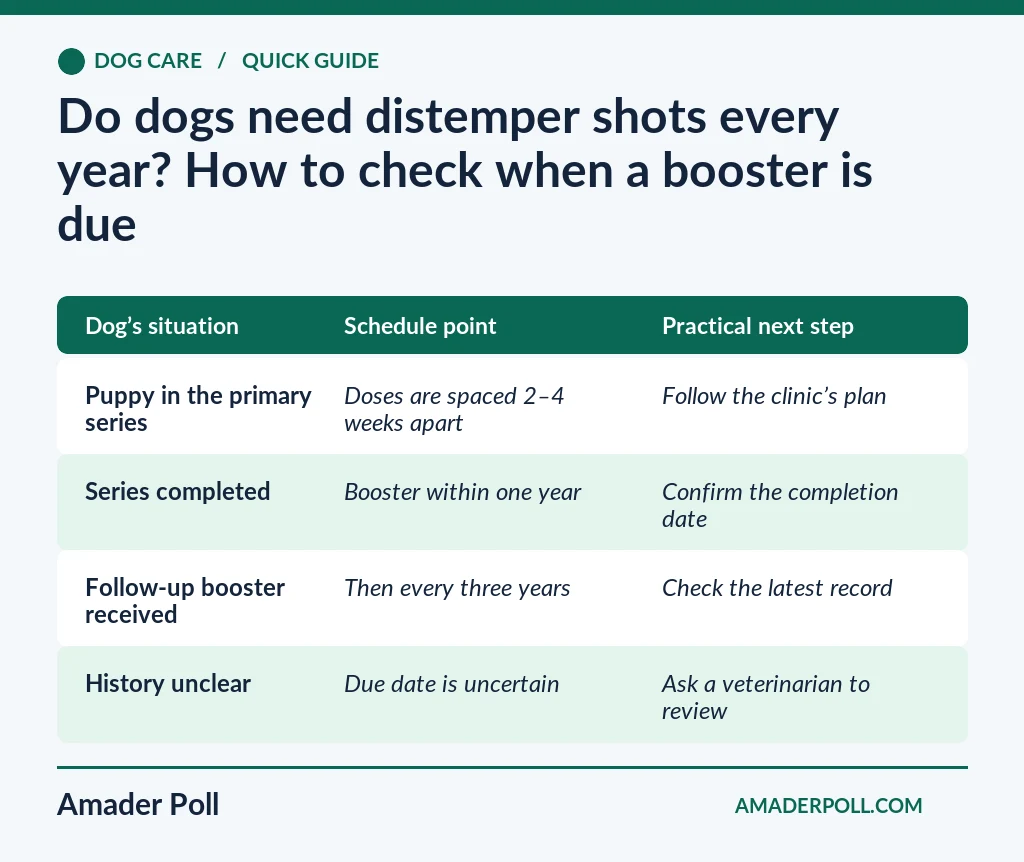
| Dog’s situation | Schedule point | Practical next step |
|---|---|---|
| Puppy in the primary series | Doses are spaced 2–4 weeks apart | Follow the clinic’s plan |
| Series completed | Booster within one year | Confirm the completion date |
| Follow-up booster received | Then every three years | Check the latest record |
| History unclear | Due date is uncertain | Ask a veterinarian to review |
These intervals apply to distemper, not necessarily to every vaccine on the record. AAHA separates core vaccines from noncore vaccines, which may be recommended according to location, lifestyle, and exposure risk. A dog starting daycare, for instance, may prompt a discussion about group-setting exposures even if its distemper booster is not due. AAHA recommendations for core and noncore canine vaccines
What to do with missing or overdue records
If the record is incomplete, first ask the current clinic whether it can obtain details from a previous veterinarian, shelter, or other provider. A date and vaccine name can clarify what was given; a vague note that the dog “had its shots” may not show whether the distemper series or follow-up booster was completed. Bring any paperwork or digital records you can find.
For overdue vaccinations, AAHA advises consulting the specific vaccine manufacturer’s instructions. Its general guidance for dogs with unknown immune status or vaccination history is “when in doubt, vaccinate,” but the veterinarian still needs to decide how that applies to the dog and vaccine in question. Do not assume that every overdue dog should simply follow the routine annual schedule or automatically restart a series. AAHA core and noncore canine vaccine schedule
If you cannot find any records, say so clearly when making the appointment and ask what information the veterinarian needs. AAHA’s table includes a general initial protocol for dogs older than 16 weeks, but a veterinarian should determine whether that framework fits the dog’s history and the specific vaccine. The goal is to establish a clear plan from the available information, not to guess at a due date.
A veterinarian may also discuss an antibody titer, which is a blood test that measures certain antibodies. The American Veterinary Medical Association says titers may help a veterinarian assess whether there is a reasonable expectation of protection for the time being, but they do not replace vaccination programs. Ask whether a titer is relevant to the specific question rather than assuming it takes the place of a recommended vaccine. AVMA information on pet vaccinations and antibody titers
Distemper and rabies have different timing rules
Distemper and rabies are both listed as core vaccines in AAHA’s general recommendations, but that does not make their schedules interchangeable. For distemper, AAHA describes a puppy series, a booster within one year, and then boosters every three years. Rabies vaccination is administered as required by law, so the applicable rules and the dog’s rabies record determine its timing. AAHA core and noncore canine vaccine schedule
Do not use the distemper due date to work out when rabies vaccination is required, or assume that a distemper booster satisfies a rabies requirement. Check the rabies certificate and ask the clinic about the rules that apply where you live. AAHA advises following local laws and consulting the state veterinarian as needed for rabies. AAHA core and noncore canine vaccine schedule
If an appointment reminder mentions vaccines without naming them, ask what is proposed and why each item is due. A reminder may cover rabies, a risk-based vaccine, or a general review rather than an annual distemper booster. Getting the vaccine names and dates makes it easier to follow the right schedule for each one.
Annual checkups are not the same as annual shots
AAHA recommends assessing patients at least annually to determine their vaccine requirements. That review can take account of changes in travel, location, or exposure, even when a distemper booster is not due that year. An annual checkup is therefore a chance to review the schedule, not evidence that every vaccine needs to be given annually. AAHA recommendations for core and noncore canine vaccines
Tell the veterinarian about the dog’s usual activities and any planned changes. The AVMA recommends considering lifestyle, travel, and contact with other animals when discussing vaccine needs. It notes that Bordetella and canine influenza vaccines may be relevant for dogs visiting places where dogs gather, while Lyme vaccination relates to exposure to ticks in affected areas. These considerations are separate from the routine distemper interval. AVMA information on pet vaccinations
For example, a dog that begins daycare may need a conversation about exposure-related vaccines while remaining current on distemper. A dog that spends most of its time indoors still falls under the general recommendation for distemper as a core vaccine, unless there is a specific medical reason not to vaccinate. The practical distinction is to review each vaccine on its own schedule, rather than treating an annual appointment as a single annual shot date. AAHA recommendations for core and noncore canine vaccines
At the annual visit, ask the clinic to name each planned vaccine, explain why it is due, and note when the next distemper booster is expected. This helps separate routine preventive care from vaccine timing and creates a clearer record for future appointments. For more pet-care topics, visit Amader Poll’s Pet category; our Editorial Policy explains how our content is prepared.
Frequently asked questions
Can a dog get a distemper shot every year?
A veterinarian may recommend an individual plan, but AAHA’s general schedule does not call for annual distemper boosters after the primary series and follow-up booster. The later interval is every three years. AAHA guidance on canine distemper
How often does an adult dog need a distemper booster?
After the primary series, AAHA recommends a booster within one year, followed by boosters every three years. Check the record to see which step comes next.
Does an indoor dog still need the distemper vaccine?
Distemper is a core vaccine recommended for all dogs unless there is a specific medical reason not to vaccinate. Indoor living alone does not change that general recommendation. AAHA recommendations for core and noncore canine vaccines
Is distemper vaccination the same as rabies vaccination?
No. They are separate vaccines with different timing considerations, and rabies vaccination follows applicable law.
What if I do not know my dog’s vaccine history?
Tell the veterinarian and share any records you can locate. The clinic can review the history and determine what schedule applies.
Can a titer test replace a distemper shot?
Not as a general rule. Titers may help a veterinarian assess expected protection, but they do not replace vaccination programs. AVMA information on pet vaccinations and antibody titers
The bottom line
For most dogs following AAHA guidance, the answer to do dogs need distemper shots every year is no. The general schedule is a puppy primary series, a booster within one year after that series, and then distemper boosters every three years. Check the vaccination record to establish which step your dog has reached. AAHA guidance on canine distemper
Keep annual veterinary reviews separate from annual shots, and check rabies requirements separately from distemper timing. If records are missing or overdue, ask a veterinarian to review the history and the applicable vaccine guidance before deciding what is due.