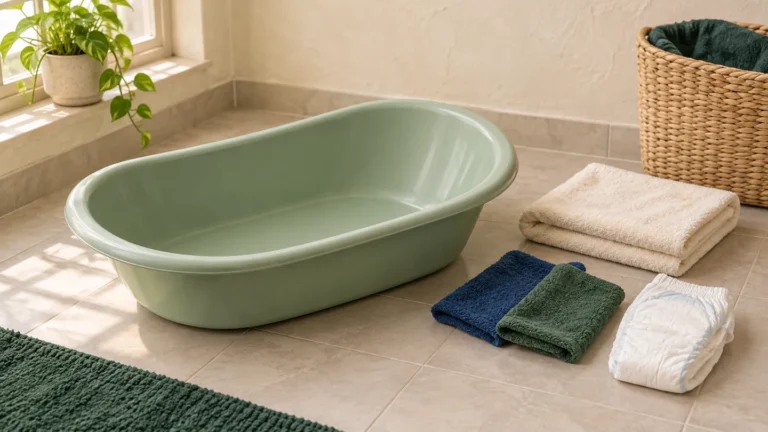
how to bathe a newborn in a sink safely
A sink may be useful during bath time without being the place your newborn sits in water. It can serve as a work area for preparing washcloths and supplies, while your baby stays on a flat surface for a sponge bath. If you are deciding how to bathe a newborn in a sink, first consider whether to use it as the basin at all, because fixtures, space, and your ability to support your baby all matter.
This guide explains how to assess those two setups, prepare a clean and manageable space, and recognize when to pause or choose an alternative. Newborns need close attention around water, so decide how you will keep your baby supported before you begin. American Academy of Pediatrics guidance on newborn bathing
1. Decide whether the sink is a work area or a basin
For a sponge bath, your baby remains on a flat surface while you use a damp washcloth and a separate basin of water. The sink can be a convenient place to prepare or refresh supplies, but your baby does not go into standing water. This distinction is useful when a sink is crowded with a faucet or handles, or when its shape makes it hard to keep your hands in a comfortable position.
A counter beside the sink can be one place to set up for a sponge bath, but it is raised and needs careful attention. Pad a hard surface with a towel or blanket, and keep a hand on your baby throughout to help prevent a fall. Never turn away to fill a basin, retrieve a cloth, or answer a message while your baby is on the counter. AAP sponge-bath safety instructions
Using the sink as a basin means placing your baby in water inside the sink. Before choosing that arrangement, check whether the basin gives you enough room to support your baby and keep them clear of the faucet and handles. If you would have to stretch, lean over awkwardly, or shift your grip around a fixture, treat that as a reason to use the sink for supplies instead. A suitable infant tub or sponge bath may be more manageable.
2. Prepare the space before bringing your baby over
Gather the items you expect to need first, such as a clean washcloth, a dry towel, a diaper, and clothes. For a sponge bath, have a separate basin of water ready as well. Put these things within reach so you do not need to leave your baby to fetch them. If you discover that something is missing during a water bath, take your baby with you rather than leaving them in or beside the water. AAP guidance on bath preparation and supervision
If your baby will lie beside the sink, clear the surface of clutter and make sure it is flat and comfortable. A towel or blanket can pad a hard surface, but it does not make a raised surface safe if you step away. Keep your baby within reach, and uncover only the area you are washing while the rest of their body stays wrapped in a dry towel. This helps you focus on one small task at a time.
If you plan to use the sink as a basin, clean and rinse it before filling, and check that the surface is in good condition. Remove items that could get in the way, including bottles, sponges, and cleaning supplies. This is a practical preparation step, not a reason to add a towel or other makeshift material inside the basin as a support. If the sink is too small or awkward to work over, switch to a sponge bath or an infant tub.
3. Check the fixtures, water, and sink shape
Look at the faucet, handles, basin edges, and drain before deciding whether the sink can work as a bath. Faucets and handles may stick out into the area where you need to position your hands and support your baby. A sink can also be slippery, so consider whether you can maintain a stable position without reaching across the basin. If the fixtures crowd the space or interfere with your hold, do not use that sink as the bath basin. AAP guidance on sink bathing safety
Fill the basin before bringing your baby over, then turn off the faucet. Do not bathe your baby in running water or use a faucet sprayer; water temperature can change as it moves through household pipes and may cause a scald. Check the water with the inside of your wrist or elbow to make sure it feels warm, not hot. The AAP recommends about 2 inches of water in the basin. AAP guidance on faucet use and water temperature
Use this quick check before placing your baby in any water. If even one part of the setup does not feel manageable, choose a sponge bath or a suitable infant tub instead. The check is about whether you can keep the water still and your baby supported, not about making a sink fit at all costs.
| Check | Proceed only if | Choose another setup if |
|---|---|---|
| Faucet | Off and out of the way | It crowds the basin |
| Basin | Clean and manageable | Slippery or cramped |
| Water | Shallow and warm | Running or too hot |
| Support | You can keep a hand on baby | You must let go |
4. Keep support continuous and secure
A newborn cannot sit up or steady themselves in a basin. Before placing your baby in water, think through how you will support their head and body and prevent them from sliding. Do not rely on the shape of the sink, a rolled towel, a cushion, or another improvised insert to hold your baby in place. If you cannot support your baby securely with your hands, use a different bathing arrangement.
Keep a hand on your baby throughout a water bath and stay close enough to reach them immediately. Have the towel and other supplies ready before you begin, so you do not need to move away. If the doorbell rings, your phone sounds, or you need to get something, lift your baby out and take them with you before responding. The AAP calls for touch supervision during bath time. AAP touch-supervision guidance
Even a small amount of water can be a hazard. The U.S. Consumer Product Safety Commission identifies sinks among household containers where children have drowned and advises never leaving a baby alone in a bathtub, even for a second. Keep your baby within arm’s reach for a sink bath or an infant-tub bath, too. Bath seats are not a substitute for your support; the AAP warns they can tip. CPSC home drowning prevention guidance
5. Keep the bath brief and notice when to stop
For a sponge bath, lay your baby on the prepared surface and keep them wrapped in a dry towel, uncovering only the part you are washing. Start with the face using a damp washcloth, taking care not to get water in the eyes or mouth, then wash the rest of the body and the diaper area. Rinse the cloth in soap-free water as needed, and pay attention to folds under the arms, behind the ears, and around the neck. AAP sponge-bath steps
Keep a first regular bath gentle and brief. Some babies protest; if yours does, pause and lift them out rather than rushing to finish. The AAP says caregivers can return to sponge baths for a week or two before trying a regular bath again when a baby protests. Wrap your baby in a towel and reassess whether the setup, timing, or chosen bathing method is making the experience difficult. AAP guidance on first regular baths
Stop if your baby begins to slide, you cannot keep them clear of the faucet, or you need to remove your supporting hand. Lift them out and place them on the prepared safe surface before changing the setup or dealing with a distraction. For example, if the faucet leaves too little room for a comfortable hold, end the water bath and finish with a sponge bath. Continue only while you can give your baby your full attention.
6. how to bathe a newborn in a sink: choose an alternative when needed
If the umbilical cord stump has not fallen off and the area has not healed, use sponge baths instead of placing your baby in bath water. The stump usually falls off at about one or two weeks of age; if it remains beyond that time, the AAP advises talking with your baby’s doctor. AAP guidance on umbilical cord care and bathing
Once the umbilical area has healed, you can consider a regular bath, but the sink does not have to be the basin. The AAP describes a hard plastic infant tub with a sloped, textured surface or sling as an option. Use any infant tub according to its instructions, and choose a sponge bath if you cannot keep your baby securely supported in the available space. AAP guidance on infant tubs and sink bathing
A sink can still make bath time easier as a preparation area, even when it is not a suitable place for your baby to sit in water. Set out a separate basin and washcloth for a sponge bath, or use the sink to arrange supplies before using an infant tub. Newborns do not need a full bath every day; the AAP says three baths per week during the first year may be enough because more frequent bathing can dry the skin. AAP guidance on how often to bathe a baby For more on timing and frequency, see our newborn bathing guide, or browse the Baby Bath section.
Frequently asked questions
Can I bathe my newborn directly in a kitchen sink?
Not before the umbilical area has healed. After that, consider it only if the sink is clean and manageable, its fixtures are out of the way, and you can support your baby continuously. Otherwise, use a sponge bath or a suitable infant tub.
Should the faucet run while my baby is in the sink?
No. Fill the basin first and turn off the faucet before your baby goes in; do not use running water or a faucet sprayer. AAP faucet and water-temperature guidance
How much water should I put in the basin?
The AAP recommends about 2 inches. Check that it feels warm, not hot, on the inside of your wrist or elbow before placing your baby in it. AAP water-temperature guidance
Can I use a rolled towel or insert to support my baby?
Do not improvise a support inside the sink. If you cannot support your baby securely with your hands, choose a sponge bath or suitable infant tub.
When should I give a sponge bath?
Use sponge baths until the umbilical stump falls off and the area has healed. Ask your baby’s doctor if the stump remains beyond about one or two weeks. AAP umbilical-area bathing guidance
What if my baby cries during a regular bath?
Pause and lift your baby out if needed. The AAP suggests returning to sponge baths for a week or two before trying again if your baby protests. AAP guidance on first regular baths
The bottom line
how to bathe a newborn in a sink starts with deciding whether the sink is a work area or a suitable basin. If its fixtures, shape, or your position make steady support uncertain, use it for supplies and choose a sponge bath or infant tub instead.
Prepare everything beforehand, fill the water before bringing your baby over, and turn off the faucet before a water bath. Keep a hand on your baby and stop if you cannot maintain support or attention. Use sponge baths until the umbilical area has healed, and ask your baby’s health care provider about individual care questions.