
puppy feeding guide by weight: use the food label
A puppy’s weight can help you find a starting point on a feeding chart, but it does not produce one universal portion. Food labels differ, and the right row may depend on your puppy’s age and whether the chart asks for current weight or expected adult weight. This puppy feeding guide by weight explains how to identify the right chart, use it as a starting estimate, and know when to check in with your veterinarian.
The aim is steady growth, not the fastest possible weight gain. A food intended for growth, regular weight checks, and adjustments based on your puppy’s progress are more useful than applying a generic calorie formula or copying another puppy’s portion. Find more dog-care articles in Amader Poll’s Pet category.
Start with the food’s life-stage statement
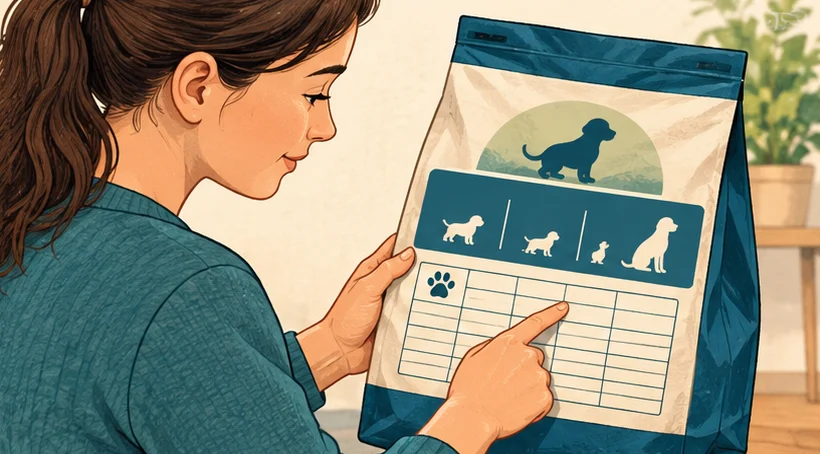
Before using the feeding chart, check that the food is intended for puppies or growth. FDA explains that a “complete and balanced” statement means a food is intended as a sole diet, and that nutritional adequacy can be established by meeting an AAFCO nutrient profile or passing an AAFCO feeding trial. Its page distinguishes the growth-and-reproduction profile from adult maintenance, which matters because growing puppies have different nutritional needs from adult dogs. FDA guidance on complete and balanced pet food
Read the full nutritional adequacy statement rather than relying only on large words on the package front. A food described as “all life stages” may have a different suitability statement from one labeled for growth, and a general growth claim does not by itself establish that a food is formulated for large-breed puppies. FDA notes that labels may refer to an AAFCO nutrient profile or feeding trial; check the statement for those details. FDA guidance on complete and balanced pet food
The feeding chart is specific to that product, so use the chart on the food you are actually feeding, not one copied from another brand. Check its units, age ranges, weight headings, and whether it gives a daily amount or an amount per meal. If the chart is hard to interpret, take a clear photo of the label and ask your veterinarian or the manufacturer to clarify it rather than borrowing a number from a different product.
Use a puppy feeding guide by weight without mixing up inputs

A chart may ask for your puppy’s present weight, expected weight as an adult, or both. These are not interchangeable: current weight describes the puppy today, while expected adult weight is an estimate of eventual size. Merck Veterinary Manual describes puppy growth in relation to anticipated adult weight and notes that growth patterns vary, so adult-size estimates are useful context but do not replace following the chart’s exact instructions. Merck Veterinary Manual on feeding practices in small animals
If the label asks for current weight, weigh your puppy and use that measurement in the appropriate age row. If it asks for expected adult weight, use a reasonable estimate based on breed or mix and your veterinarian’s assessment, especially when the puppy’s background is uncertain. For example, a mixed-breed puppy whose likely adult size is unclear should not automatically be assigned the largest weight category; ask the clinic which estimate fits that chart.
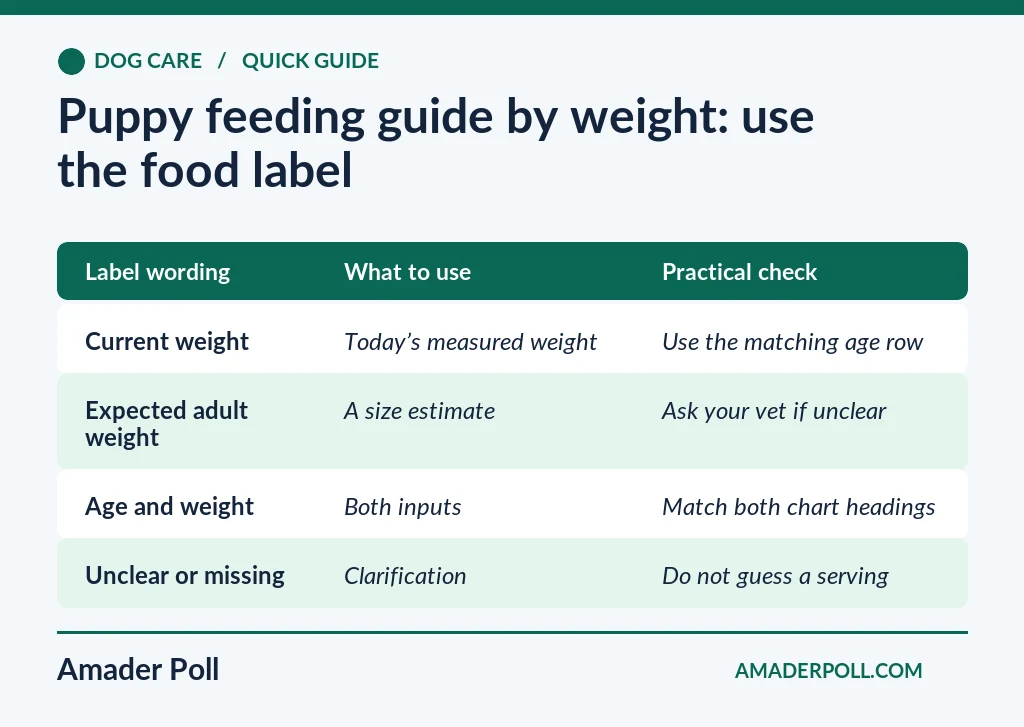
Use this table to avoid mixing up the chart’s inputs, not as a portion calculator. It provides no feeding amounts because the product’s own chart supplies the starting figure. When a chart combines age and weight, match both rather than choosing a row based on weight alone.
| Label wording | What to use | Practical check |
|---|---|---|
| Current weight | Today’s measured weight | Use the matching age row |
| Expected adult weight | A size estimate | Ask your vet if unclear |
| Age and weight | Both inputs | Match both chart headings |
| Unclear or missing | Clarification | Do not guess a serving |
Turn the chart into a starting daily portion
Once you identify the right row, treat its amount as a starting point for the day unless the label clearly says otherwise. Check whether the quantity is stated in cups, grams, cans, or another measure, and use the same kind of measure when portioning. A “cup” should not be assumed to mean any household mug or scoop; use a consistent measure so day-to-day servings are comparable.
Divide the daily amount into meals that suit your puppy’s age and routine, while keeping the daily total in view. Merck recommends three meals a day for puppies between weaning and 6 months and two meals daily for puppies 6–12 months; it also notes that feeding practices should be individualized. These are general recommendations, not a rule that overrides a food label or advice for an individual puppy. Merck Veterinary Manual on feeding practices in small animals
Keep track of treats and snacks as part of what the puppy eats. Merck says treats should remain below 10% of total calories to help prevent nutrient deficiencies; this is a general limit, not a reason to calculate the whole diet from a guessed calorie target. Merck Veterinary Manual on feeding practices in small animals If family members share feeding duties, write down meals and treats to avoid accidentally offering duplicate portions.
Monitor progress and adjust thoughtfully

A chart cannot account for every puppy’s activity, growth pattern, or individual needs. Merck advises close, weekly monitoring of weight gains in growing puppies and adjusting feeding recommendations so the puppy gains a small amount each week; it also notes that overfeeding can increase growth rate, which is not desirable for skeletal development. Merck Veterinary Manual on feeding practices in small animals Weighing on the same scale under similar conditions makes a trend easier to interpret than a single reading.
Record the date, weight, food, and daily portion, then bring that record to routine veterinary visits. The useful question is not simply whether the puppy is bigger than last month, but whether its growth pattern appears appropriate for its individual size and stage. Merck notes that growth-rate charts are available for individual puppies and can help indicate whether a puppy is following a healthy growth pattern. Merck Veterinary Manual on feeding practices in small animals
If growth seems unexpectedly slow or fast, or weight is moving away from the pattern your veterinarian expects, contact the clinic before making a large portion change. A vet can review the puppy’s weight trend, body condition, age, and food label together. Follow-up is especially useful when expected adult size is uncertain or the chart appears to point to conflicting weight categories.
Check large-breed growth claims on the label
For a puppy expected to become large or giant, do not assume every food labeled for puppies is formulated for large-breed growth. Merck says large- and giant-breed puppies should be fed complete and balanced growth diets whose AAFCO statement indicates they are formulated for large-breed puppies, with wording that includes growth of large-size dogs weighing 32 kg or more as adults. Merck Veterinary Manual on feeding practices in small animals
Look for the actual statement on the package and check that it matches the puppy’s likely adult size. If the wording is missing, unclear, or difficult to reconcile with an expected adult weight near a category boundary, ask your veterinarian to help interpret it. This is a label check, not a reason to add nutrients: Merck says extra calcium, phosphorus, and vitamin D beyond amounts in a complete and balanced growth diet are rarely necessary and may be contraindicated. Merck Veterinary Manual on feeding practices in small animals
Large and giant breeds may also take longer to reach skeletal maturity than smaller dogs. AAHA says some large- and giant-breed dogs may not reach skeletal maturity until closer to 15–16 months, while Merck gives a broader range of 10–16 months for large and giant breeds; timing varies by dog. AAHA guidance on age-specific and breed-specific diets Merck Veterinary Manual on feeding practices in small animals Ask the vet when to review the growth diet rather than switching just because obvious growth seems to have slowed.
Avoid false precision with calorie math and food changes
Calories can be useful information, but calorie arithmetic is not a shortcut to the right portion. The food’s energy content, the label’s recommended serving, and the puppy’s individual needs all matter; a calculation based on a different food or an assumed cup weight can mislead. Use the product’s own feeding directions as your initial reference, and ask your veterinarian for help if the amount seems inconsistent with the puppy’s weight trend or the label is difficult to apply.
Switching foods can change the amount that fits the chart because products may have different instructions and energy content. Do not carry over the same scoop or serving automatically when changing products; read the new label and check its life-stage statement. FDA explains that guaranteed nutrient levels on labels are expressed on an “as-fed” basis, while nutrient profiles use a dry-matter basis, and that moisture differences affect direct comparisons between products. FDA guidance on complete and balanced pet food That comparison guidance concerns nutrient levels, not a method for calculating a puppy’s portion.
When a food change is needed, follow the new product’s directions or ask your veterinary team how to make the change for your puppy. Avoid abrupt food or portion changes, and do not change several things at once, such as switching foods while sharply increasing the amount; otherwise, it may be harder to tell what affected the routine. For information about how Amader Poll approaches published content, see the Amader Poll Editorial Policy.
Frequently asked questions
Should I use my puppy’s current weight or adult weight?
Use whichever weight the particular chart requests. If it asks for expected adult weight and you are unsure, ask your veterinarian to help estimate it.
How often should I weigh my puppy?
Merck recommends close, weekly monitoring of weight gain during puppy growth. Keep a simple record and share the trend with your veterinary team.
Can I use a feeding chart from another brand?
Use the chart for the food you are feeding. Check the new chart before transferring any portion amount from another product.
Does every puppy food suit a large-breed puppy?
No. Check the nutritional adequacy statement for wording that identifies the food as formulated for large-breed growth, and ask your veterinarian if the label or expected size is unclear.
Should I add calcium to a puppy’s food?
Do not add supplements without veterinary advice. Merck says supplementation beyond amounts in a complete and balanced growth diet is rarely necessary and may be contraindicated.
When should I call the veterinarian about portions?
Ask for guidance when weight gain seems unexpectedly fast or slow, the label is confusing, or expected adult size is uncertain. Bring the food label and recent weight record if available.
The bottom line
A puppy feeding guide by weight is most useful when you confirm the food is appropriate for growth, then match the age and weight inputs requested by that product’s chart. Keep current weight separate from expected adult weight, measure consistently, and treat the chart amount as a starting reference rather than a guarantee for every puppy.
Track weight regularly and ask your veterinarian to review the pattern, especially for a large-breed puppy or one whose likely adult size is hard to estimate. Check the new label whenever the food changes, and avoid relying on generic calorie math or a portion copied from another product; a careful trend and informed follow-up are more useful than guessing from one weigh-in.