

feeding chart for dogs: A Practical Guide
A feeding chart for dogs can help you set a routine, but it cannot tell you exactly what every dog needs. Life stage, activity, health, the food’s calorie content, and your dog’s body condition all matter. Use the package guide as a starting point, then check the amount you serve and how your dog is doing over time.
The practical goal is to make meals measurable and the full daily intake visible. Check that the food suits your dog’s life stage, account for treats and leftovers, and keep a simple record. If your dog is growing, has a health condition, or shows a lasting change in appetite or body condition, bring that information to your veterinary team.
1. feeding chart for dogs: Start with the food label
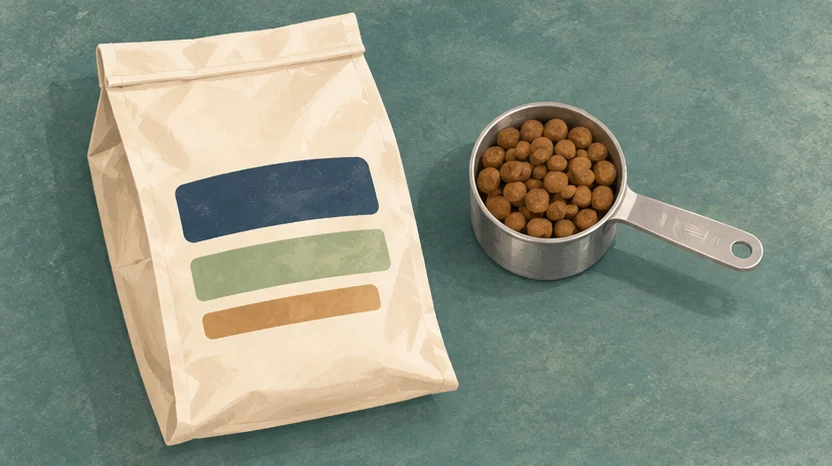
Begin with the nutritional adequacy statement, not the front-of-package pictures or a broad marketing phrase. A “complete and balanced” statement indicates that a food is intended to serve as a pet’s sole diet and meets a nutrient profile or has passed a feeding trial using AAFCO procedures. Treats and supplements are typically not intended to be a sole diet, so check that the main food is appropriate for your dog’s life stage. FDA guidance on complete and balanced pet food
Next, find the feeding guide and calorie information for the exact food you use. The guide offers a starting amount, while the calorie statement helps you understand how much energy a measured serving contributes. A cup of one recipe may not provide the same calories as a cup of another, and an unmarked scoop can vary between servings. If calorie information is absent, WSAVA says owners can ask the manufacturer for it. WSAVA guidance on selecting pet foods
Treat the package range as guidance rather than a fixed prescription. Two dogs of similar size can have different routines and health circumstances, and a feeding chart cannot account for every individual difference. Start with the package’s direction for the correct food and life stage, measure what you actually serve, and review your dog’s condition instead of choosing a portion solely by body weight. For additional general pet-care material, see the Pet category.
2. Match the plan to life stage
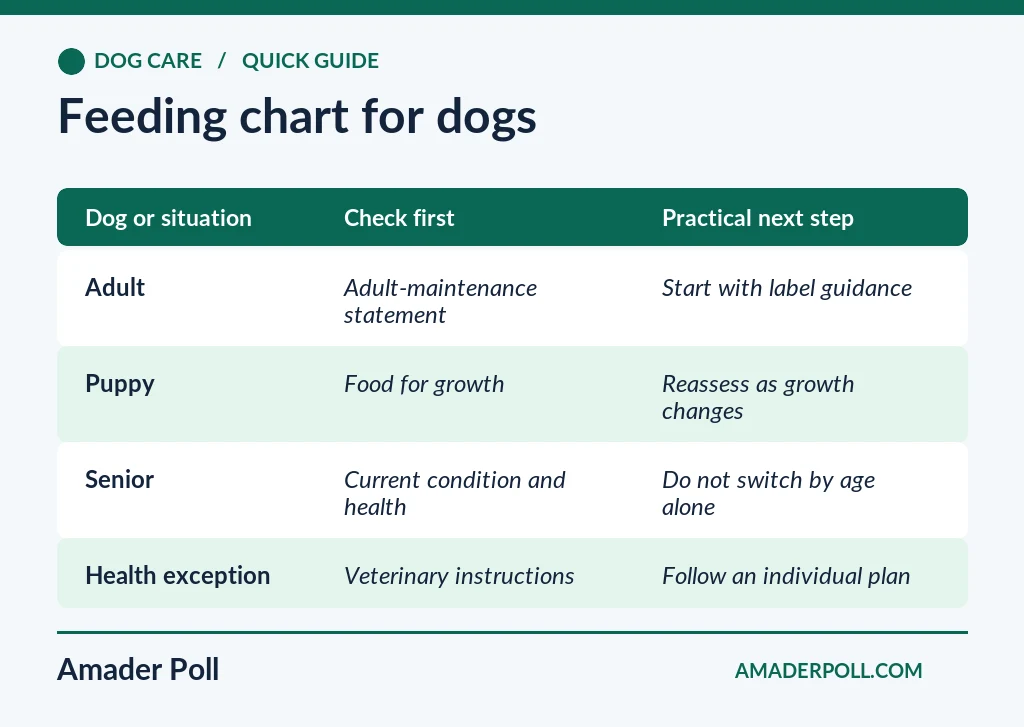
Life stage matters because a growing puppy has different nutritional needs from an adult dog. FDA describes separate nutrient profiles for growth and reproduction and for adult maintenance, so check the food’s adequacy statement rather than relying on a product name alone. The table is a decision aid: it identifies what to verify, not a set of portions or a command to change diets on a certain date. FDA guidance on complete and balanced pet food
| Dog or situation | Check first | Practical next step |
|---|---|---|
| Adult | Adult-maintenance statement | Start with label guidance |
| Puppy | Food for growth | Reassess as growth changes |
| Senior | Current condition and health | Do not switch by age alone |
| Health exception | Veterinary instructions | Follow an individual plan |
Puppies should eat food appropriate for growth until skeletal maturity. This often occurs at about one year for small and medium dogs, while some large and giant breeds may not reach skeletal maturity until closer to 15–16 months. These are broad patterns, not a universal deadline; ask the veterinary team when to review a puppy’s food, particularly for a large or giant breed. AAHA guidance on age-specific diets For help reading the package chart, see our puppy feeding guide by weight.
Age alone does not mean an older dog needs a “senior” food. AAHA notes there are no specific AAFCO nutrient requirements for mature, senior, or geriatric pets, and an older dog doing well on a complete adult-maintenance diet may continue on it unless a medical condition prompts a change. Use an age-related checkup to review the individual dog’s needs, not as an automatic diet-change date. AAHA guidance on age-specific diets
3. Read calories and work through the serving math
A feeding guide and a calorie statement answer related but different questions. The guide suggests an amount to begin with; calories per cup, can, or other unit show how that serving contributes to the day. Make sure the unit in your calculation matches the label. If the package lists calories per can, for example, do not treat that number as calories per cup. For a food without clear calorie details, ask the manufacturer rather than estimating from the ingredient list. WSAVA guidance on selecting pet foods
Here is a clearly hypothetical label-reading example, not a feeding recommendation. Suppose a label says one cup contains 400 calories, and a veterinarian has discussed a hypothetical daily starting target of 800 calories for a particular dog. Dividing 800 by 400 gives two cups for the full day before accounting for other foods. The arithmetic demonstrates how to use label information; neither the target nor the resulting amount applies universally to dogs of any weight.
If that hypothetical daily amount were split between two meals, each would contain one cup, provided the dog received no calories from other food or treats. If some kibble is used for training, take it from the measured daily amount instead of adding it on top. With mixed foods, use the calorie information for each food and keep track of the amount given. If a therapeutic diet is part of the plan, follow the veterinary team’s specific instructions rather than this general arithmetic example.
4. Measure meals, treats, and leftovers
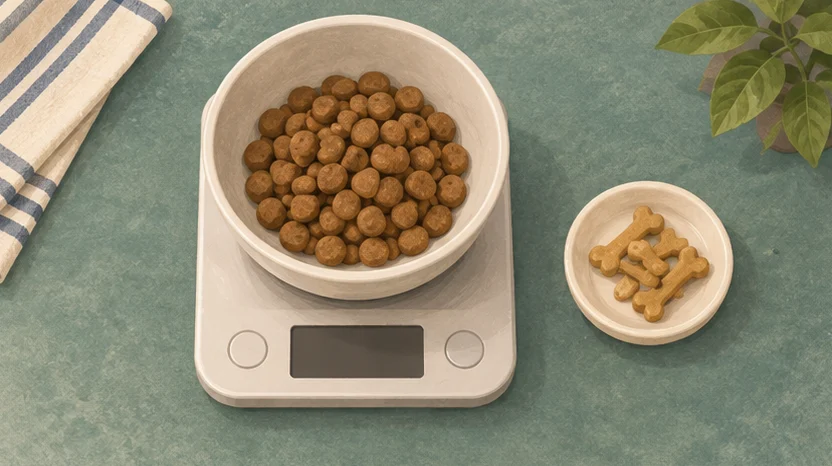
A useful routine starts by measuring the total food offered for the day. Use the same marked measuring cup or a kitchen scale, then divide that amount into the meals your household serves. The key for a feeding record is consistency: write down the measure and amount, rather than relying on “a scoop” or “about half a bowl.” Different caregivers may otherwise serve noticeably different amounts without realizing it.
Record treats, chews, table food, and training rewards alongside meals. When several people care for a dog, a shared note can prevent each person from assuming someone else has not given a treat. If practical, reserve some of the measured daily food for training rewards. FDA notes that treats and snacks are typically not intended as a pet’s sole diet; keeping them visible in the record also helps you account for the whole routine. FDA guidance on complete and balanced pet food
Log what was offered and what remained, not just whether the bowl looked empty later. A note such as “ate most of breakfast; about a quarter remained” gives a clearer picture than a general impression that the dog ate less. Review several days for a pattern, and do not automatically add food later to compensate for a single unfinished meal. If a change in appetite persists or concerns you, share the record with your veterinary team.
5. Review body condition, not just bowl size

Finishing a meal does not by itself show that a portion is right, and a full-looking bowl does not show whether a dog’s overall intake is appropriate. Pair the feeding record with regular attention to body condition. Ask a veterinary professional to demonstrate how they assess your dog’s body and muscle condition; a consistent reference is more useful than comparing your dog with another pet. FDA’s nutritional-assessment resource describes body and muscle condition scoring as part of evaluating nutrition. FDA and AAHA nutritional assessment guidance
If your dog’s condition changes, first look at the whole routine: measured meals, treats from all caregivers, leftovers, and changes in daily activity. A bowl log can reveal that the amount served is consistent while extras have increased, or that a dog regularly leaves part of a meal. These are different situations and call for different questions. Bring the notes and the food label to your veterinary team before making a major change, especially for a growing dog or one with a health concern.
When a plan needs adjustment, make one deliberate change at a time and keep recording the results. Changing the food, meal amount, treats, and schedule all at once makes it harder to tell what affected the routine. Agree with the veterinary team on when to review progress, and bring the exact food information rather than only a general description such as “dry food.” Nutritional assessment can help put body condition and feeding habits in context. FDA and AAHA nutritional assessment guidance
6. Know when a general chart is not enough
A standard package range is not a substitute for individual guidance when illness, treatment, or a therapeutic diet affects feeding. The appropriate food and amount depend on the dog’s circumstances and the veterinary plan. WSAVA advises that therapeutic diets be used under veterinary supervision, so ask how treats, toppers, training rewards, and food used to give medication fit that plan. WSAVA guidance on selecting pet foods
Puppies, pregnant or nursing dogs, and older dogs with health needs are not interchangeable exceptions. FDA includes growing, pregnant, and nursing animals within the growth and reproduction nutrient profile, which differs from adult maintenance. For a puppy, confirm the food is appropriate for growth and ask when to reassess it. For an older dog, review current health and condition rather than switching simply because the dog has reached a particular age. FDA guidance on complete and balanced pet food
When you ask for help, bring the details that make the question answerable: the exact food, its calorie information, the measured amount served, treats and extras, and notes about leftovers. If you are unsure whether a food is complete for your dog’s life stage, check its nutritional adequacy statement and ask the manufacturer or veterinary team to clarify it. FDA explains that a complete-and-balanced claim is tied to meeting a nutrient profile or passing an AAFCO feeding trial. FDA guidance on complete and balanced pet food For information about how our articles are prepared, read the Amader Poll Editorial Policy.
Frequently asked questions
How often should I feed my dog?
Keep the daily amount clear and measured, and choose meal timing that fits your dog’s needs and household routine. Ask your veterinary team about timing if your dog has a health-related feeding plan.
Can I use the same chart for every food brand?
No. Follow the guide and calorie information for the specific food, because servings can differ in calories between recipes.
Should I switch my dog to senior food at a certain age?
Not automatically. An older dog doing well on a complete adult-maintenance food may continue on it unless a medical condition prompts a change. AAHA guidance on age-specific diets
How should I account for training treats?
Record treats and other extras with meals, or use some of the measured daily food as rewards. Ask the veterinary team which treats fit a therapeutic diet.
When should a puppy move off growth food?
Puppies need food appropriate for growth until skeletal maturity. Timing varies; some large and giant breeds may not reach maturity until closer to 15–16 months. AAHA guidance on age-specific diets
What if my dog leaves food in the bowl?
Record the amount offered and what remains. If the pattern persists or concerns you, share the log with your veterinary team.
The bottom line
Use a feeding chart for dogs to establish a measured starting routine, not a universal portion by weight. Check the food’s life-stage statement and calorie information, then include treats, training rewards, and leftovers in the daily record.
Review the record alongside your dog’s body condition, and ask a veterinary professional to help assess it when you are unsure. Puppies, seniors, and dogs with health-related needs may require a more individual plan, but age alone does not decide every food change. A clear label and consistent bowl log make that conversation more useful.